Why Does AIT Exist?
AIT's Value Stance and System Beliefs
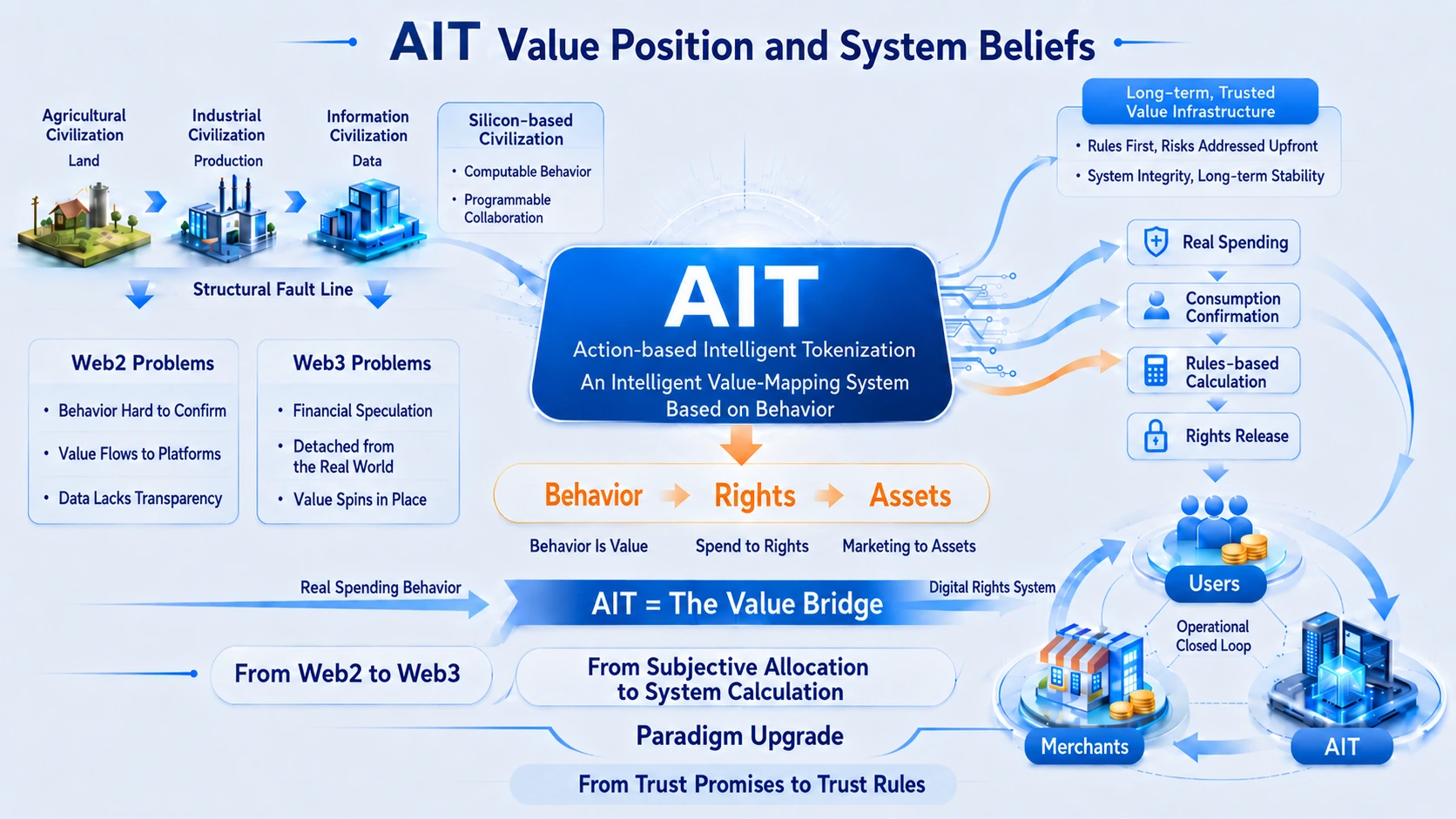
Core Answer
The structural disconnect between Web2 and Web3; real spending as the value origin; shifting from subjective allocation to system-based computation; rules-first, long-term stability.
The cognitive starting point for AIT. It shows that AIT is not a conventional consumer tool or a single-point Web3 project, but a new form of value infrastructure built around real spending.
What Problem Does AIT Actually Solve?
AIT's Market Value Proposition and Core Business
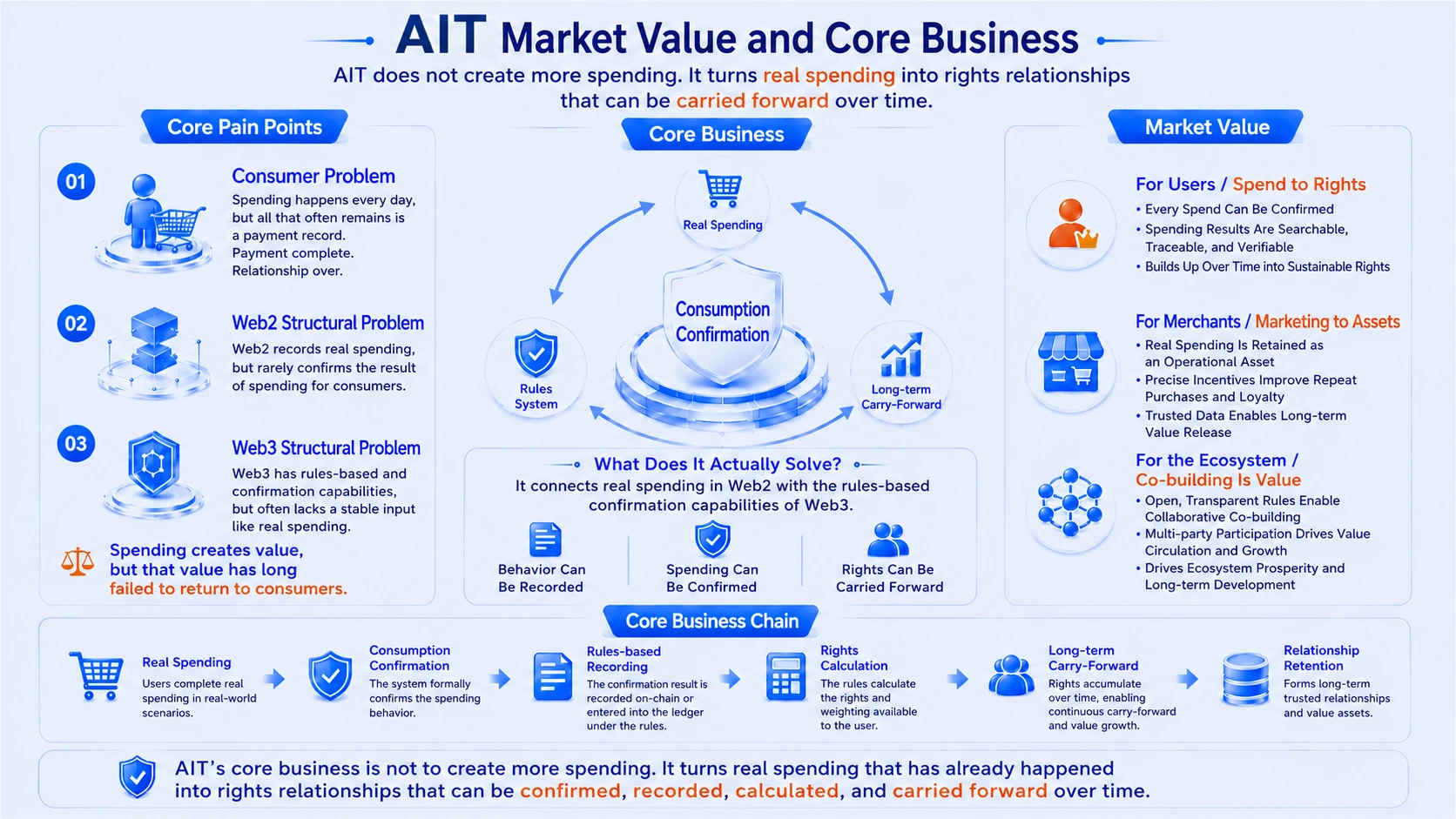
Core Answer
Consumption Confirmation as the core business; connecting real spending in Web2 with Web3's rules-based confirmation capabilities; value for users, merchants, and the ecosystem; the core business chain.
Turns an abstract concept into a clearly defined business. It shows that AIT is not a points system, rebate model, or token-based incentive model, but a system that carries real-spending value forward through Consumption Confirmation.
Where Is AIT's Market Entry Point?
AIT's Market Opportunity and Value Potential
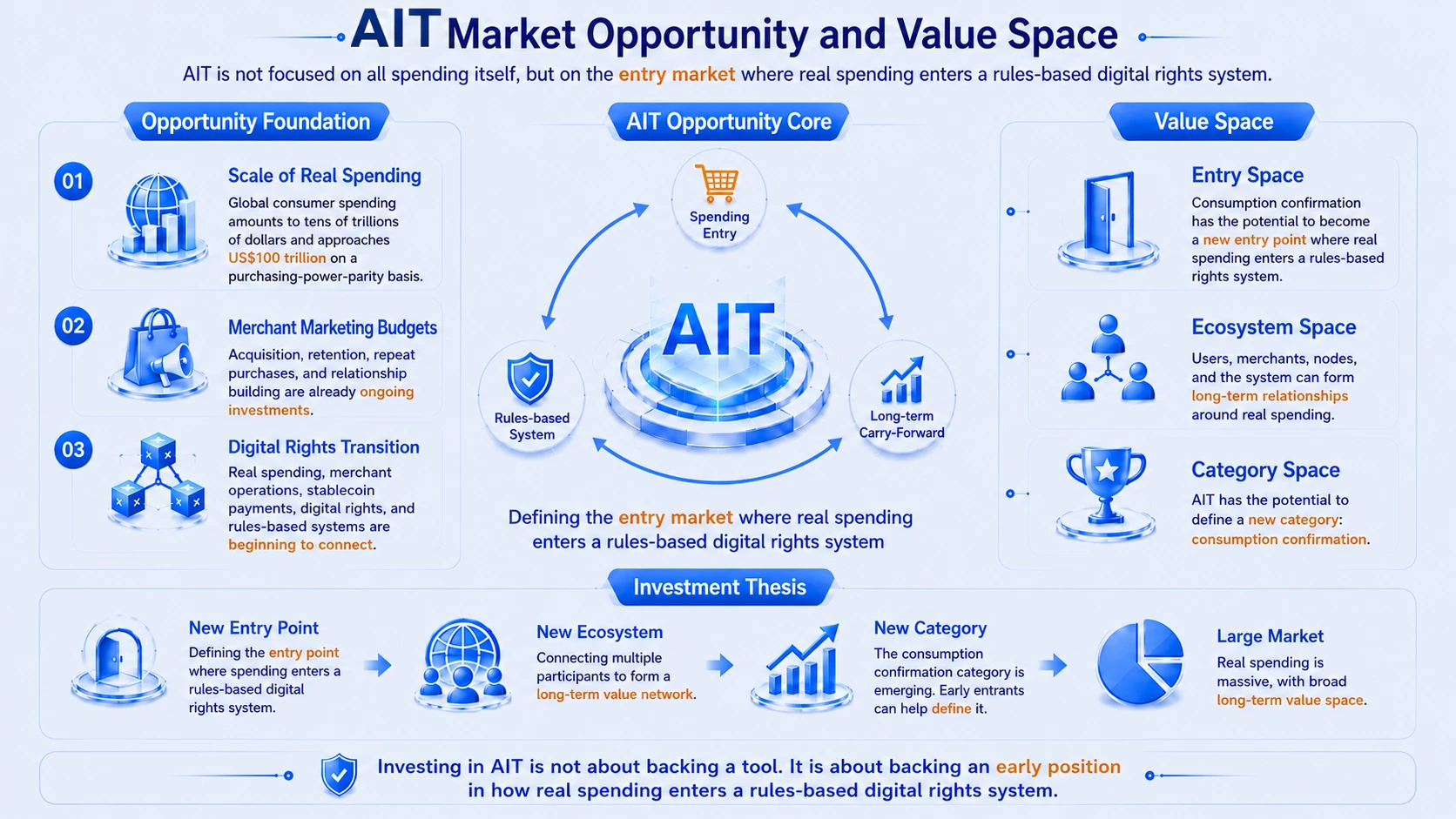
Core Answer
The scale of real spending; merchant marketing budgets; the shift toward digital rights infrastructure; and value potential across the entry point, ecosystem, category, and broader market.
Shows that AIT is not limited to one industry, store, or application. It addresses the entry-point market where real spending enters a rules-based digital rights framework.
How Does AIT Move from Design to Real-World Implementation?
AIT's Business Model and Implementation Path
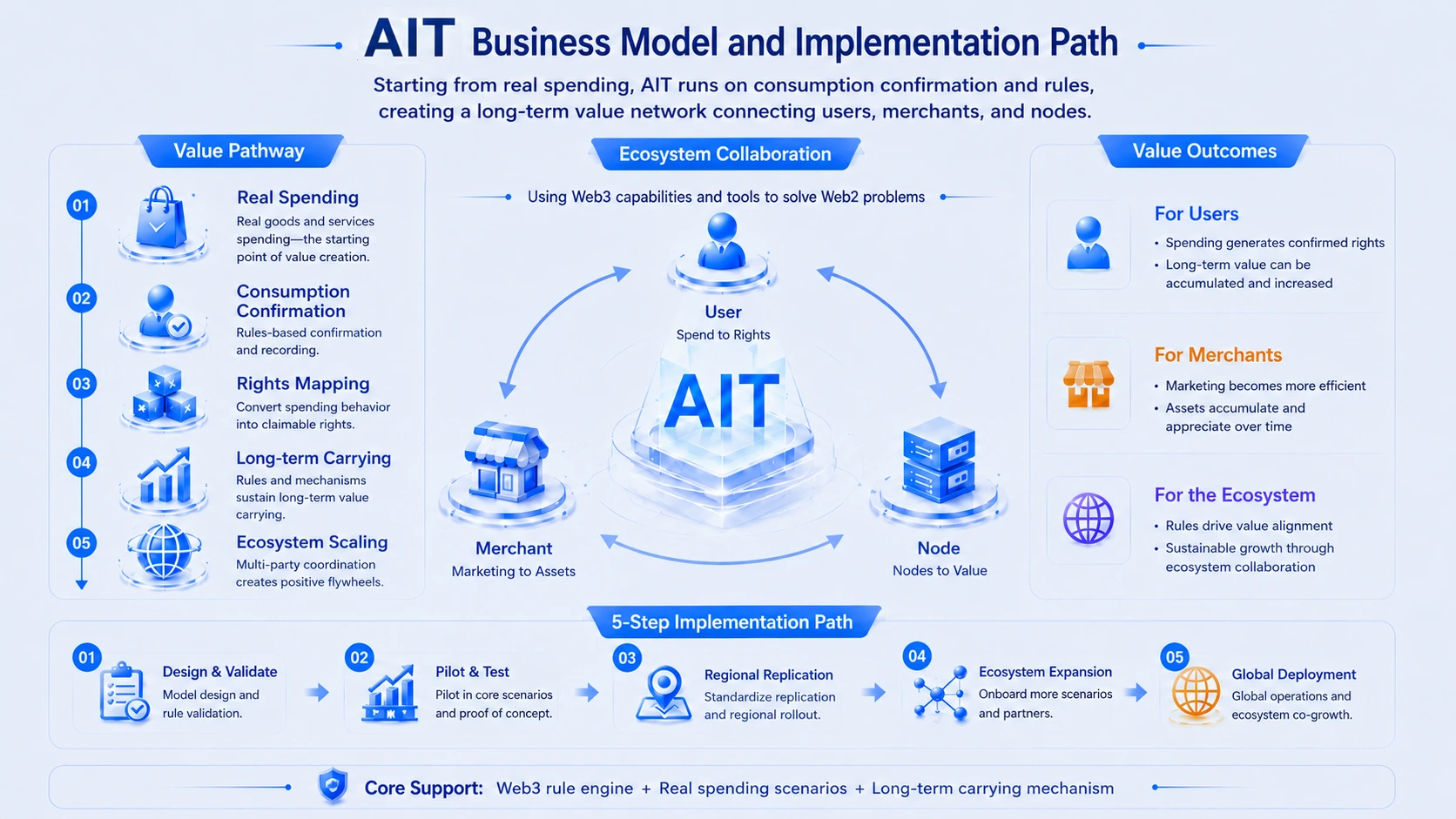
Core Answer
Real spending, Consumption Confirmation, rights mapping, and long-term rights continuity; three-party coordination among users, merchants, and nodes; value outcomes across the Three Sides; design validation, pilot deployment, regional replication, ecosystem expansion, and global rollout.
Demonstrates that AIT has a viable fee base, a functioning commercial loop, and an executable implementation path, rather than remaining a concept, slogan, or technical vision.
How Does AIT Unlock the Flow of Industrial Value?
AIT's Industry Connectivity and Value Release
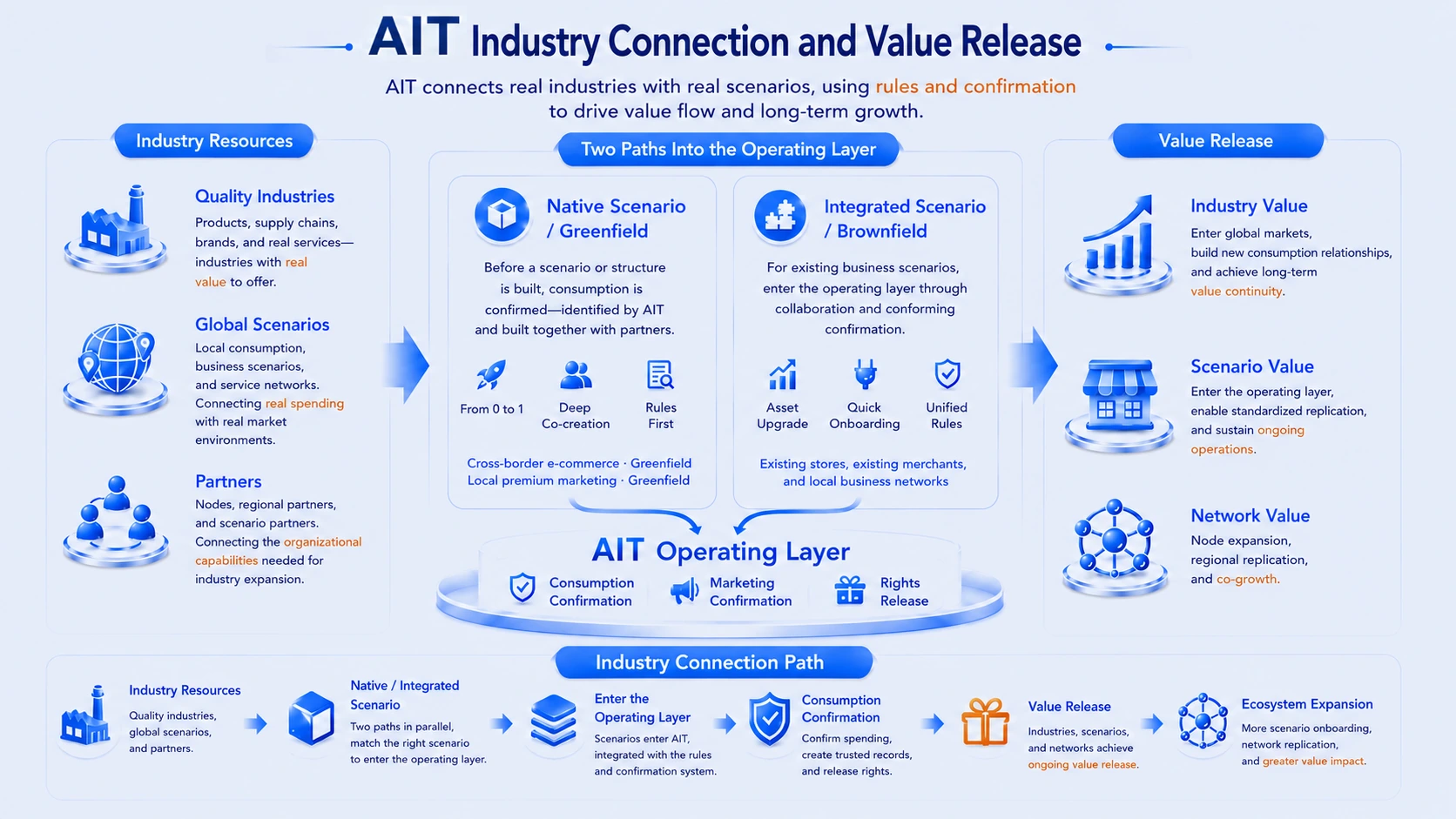
Core Answer
High-quality industrial resources, overseas market scenarios, and co-building partners; AIT Native Scenarios and AIT Integrated Scenarios, corresponding to the Native Pathway and the Integrated Pathway; the AIT Operational Layer; Consumption Confirmation, Marketing Confirmation, and rights continuity; industry value, scenario value, and network value.
Bridges AIT's system capabilities with real industries and defines the formal pathways through which different industries and operating scenarios enter the AIT Operational Layer.
How Does AIT's Ecosystem Operate?
AIT's Ecosystem and Operating Mechanism
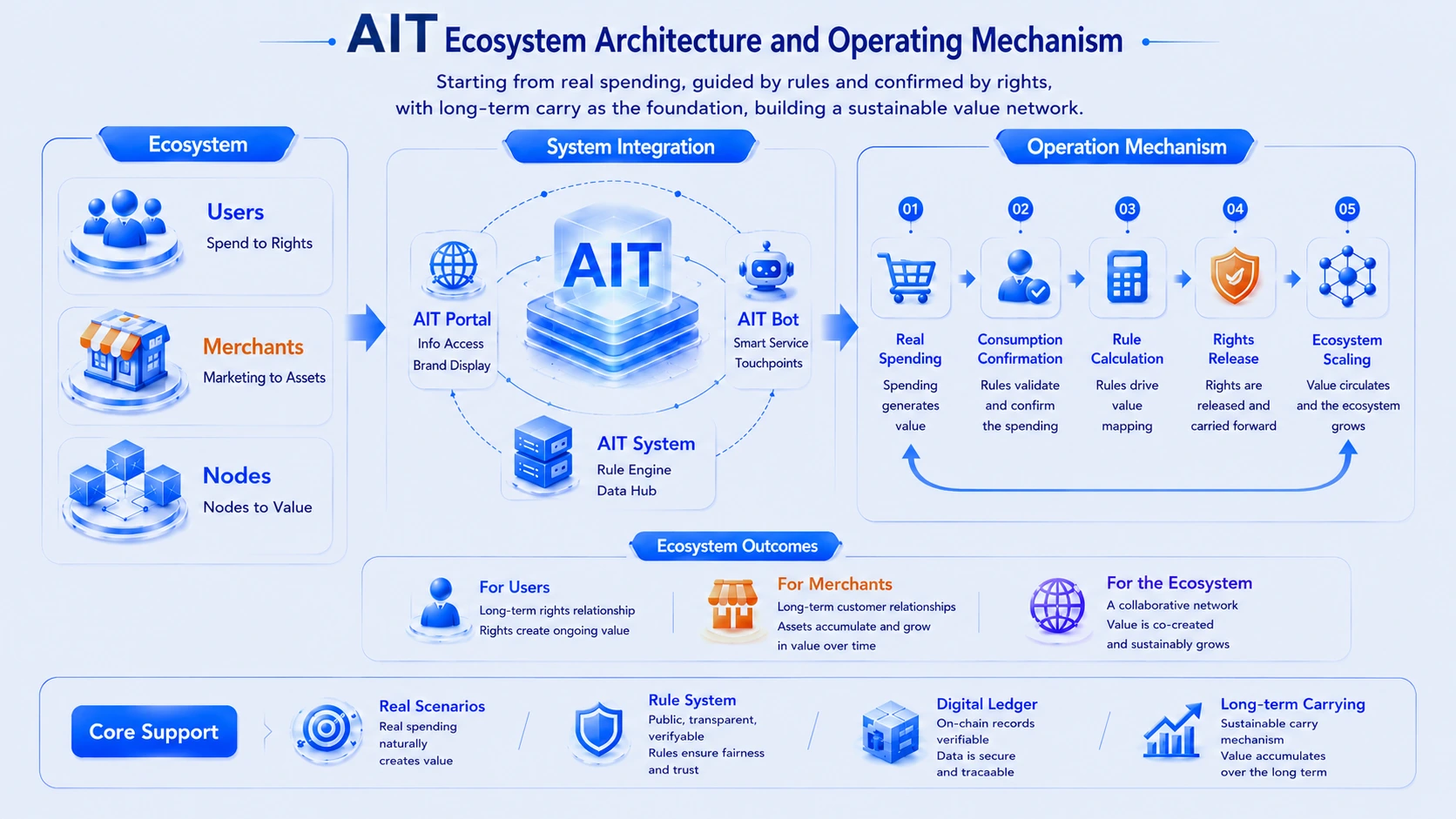
Core Answer
Users, merchants, and nodes; the official website, AIT Bot, and AIT System; real spending, Consumption Confirmation, rules-based computation, long-term rights continuity, ecosystem expansion, and the core support framework.
Demonstrates that AIT is not a single product or application, but an ecosystem infrastructure composed of participants, service entry points, a rules-based system, and a sustainable operating loop.
What Is the Economic Logic Behind AIT?
AIT's Value Model and Economic Mechanism
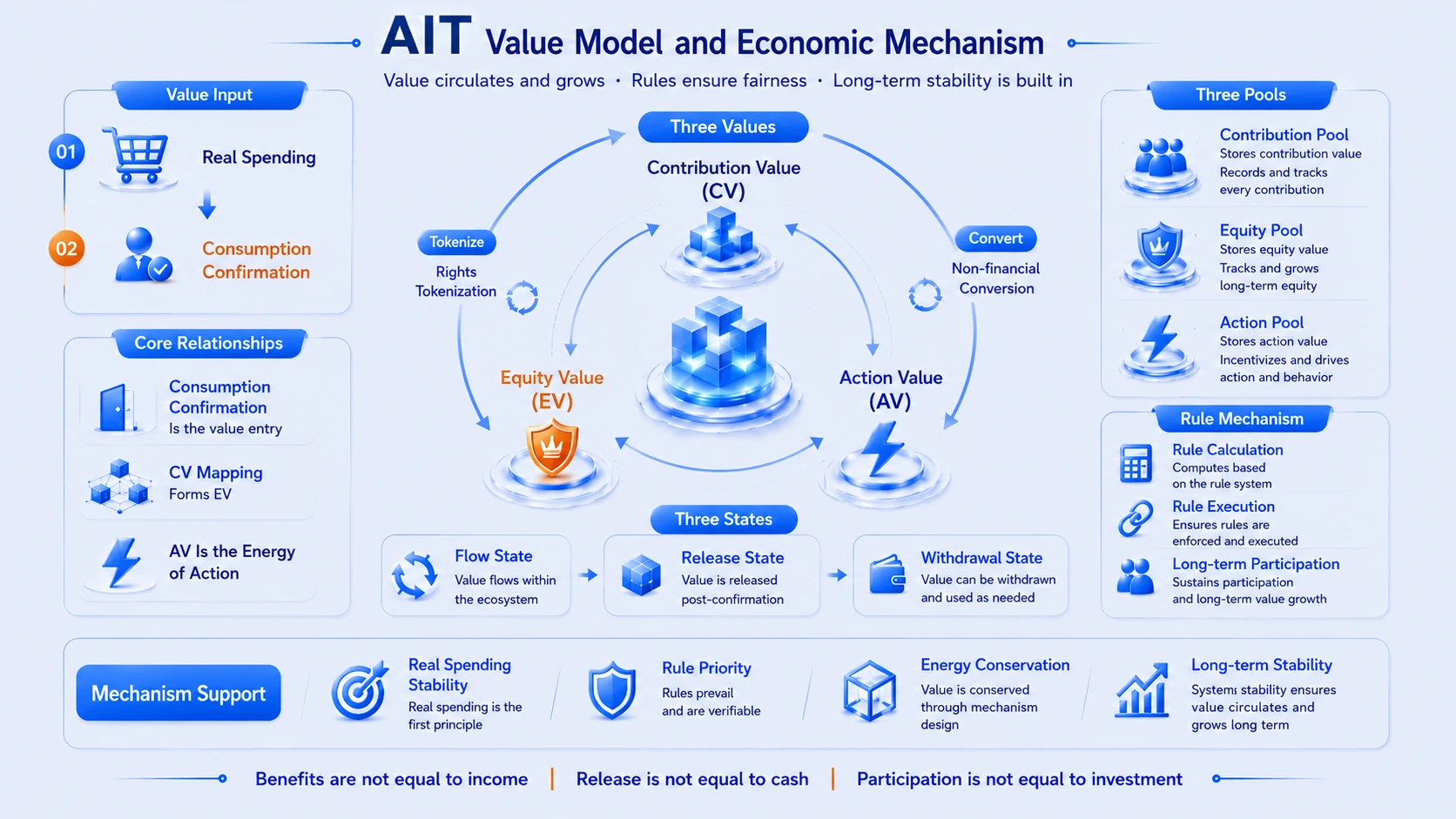
Core Answer
Real spending, with Consumption Confirmation as the Value Entry Point; Contribution Value (CV), Equity Value (EV), and Action Value (AV); Three Pools, Three States, and Two Transformations; rules-based computation, rule-based rights continuity, and long-term participation mechanisms.
Demonstrates that value is not subjectively allocated, handed out as a simple reward, or framed as a promise of returns. It is formed from real spending through a unified system of rules, computation, and mechanism-based controls.
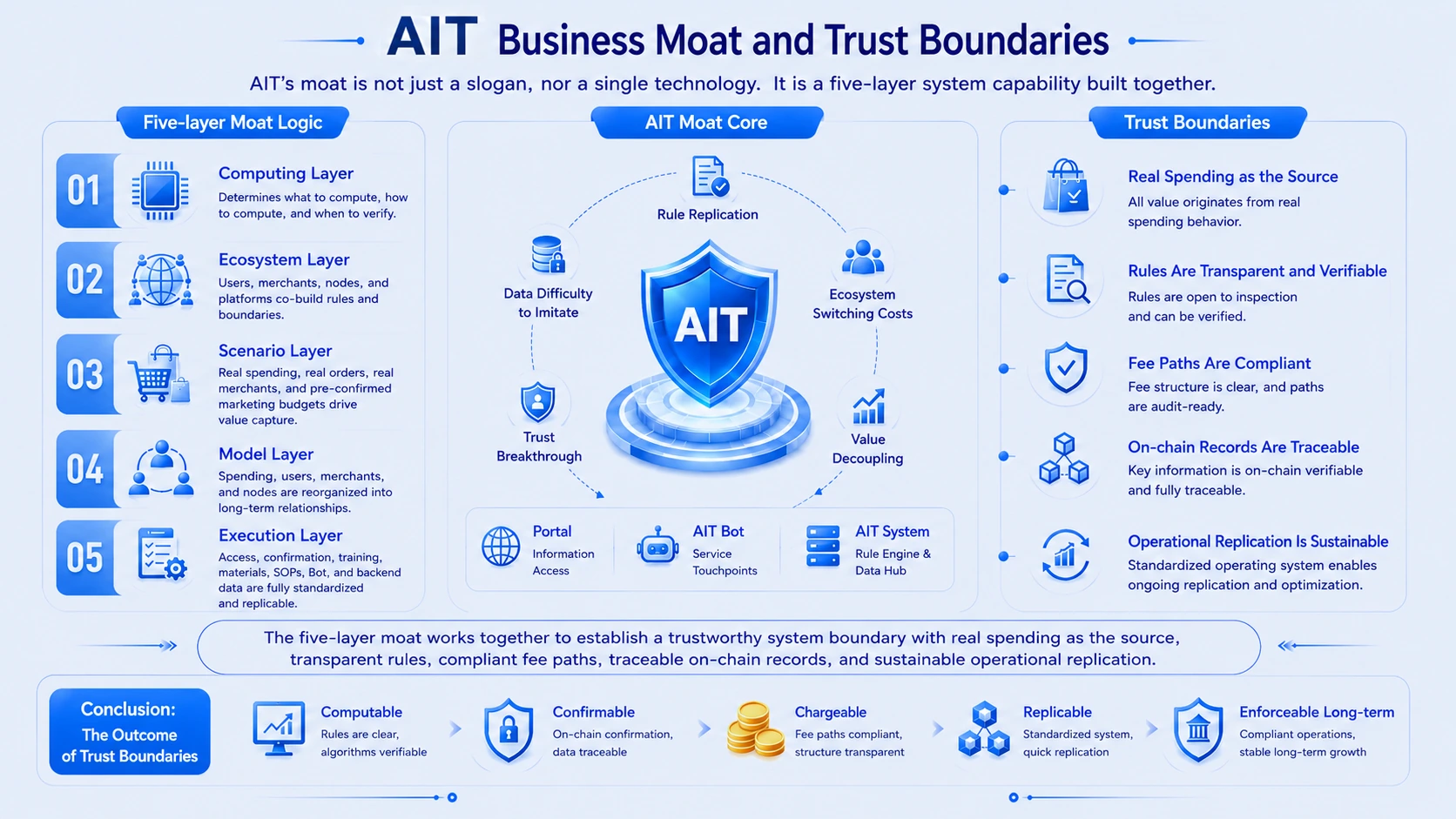
Why Is AIT Trustworthy?
AIT's Business Defensibility and Trust Boundaries
Core Answer
Five layers of defensibility: computation, full-ecosystem integration, scenario value, model design, and execution; real spending as the source; transparent and verifiable rules; compliant fee pathways; traceable on-chain records; and operations that can be replicated sustainably.
Completes the institutional trust case. It shows that AIT's defensibility comes from multiple capabilities working together, rather than from a similar slogan, a single technology, or a short-term incentive design.
Continue Exploring AIT
From understanding to action — join the AIT ecosystem and realize the full potential of real-spending-driven digital value.